

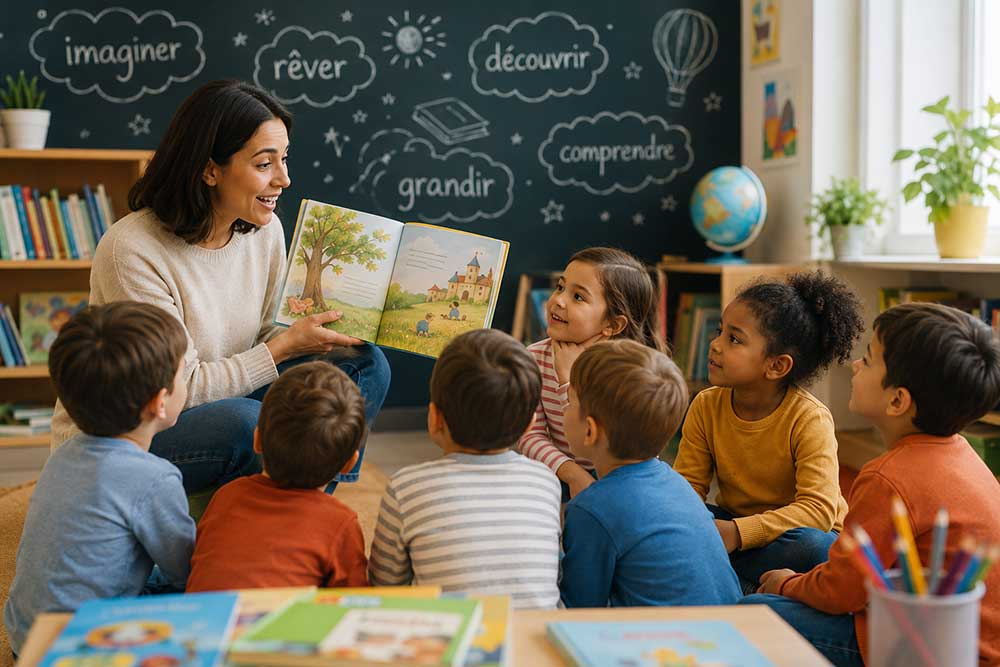
Long before children learn to read independently, they learn through stories.
Stories are much more than entertainment—they are one of the most effective ways to develop language, imagination, empathy, memory, and critical thinking. Whether told aloud, read from beautifully illustrated books, or brought to life through classroom discussions, storytelling helps children make sense of themselves and the world around them.
For educators, storytelling is not simply another classroom activity. It is a powerful teaching strategy that connects learning with emotion, curiosity, and real-life experiences.
Stories Build Language Naturally
Young learners acquire language most effectively when it is presented in meaningful contexts. Through stories, children repeatedly encounter new vocabulary, sentence structures, expressions, conversational language, and pronunciation patterns. Rather than memorizing isolated words, they discover how language is used naturally in authentic situations. This contextual learning significantly improves comprehension and communication skills.
Stories Develop Critical Thinking
A good story encourages children to think beyond the words on the page. Teachers can ask questions such as: Why did the character make this decision? What would you have done differently? What do you think will happen next? How would you solve this problem? These discussions nurture reasoning, prediction, and problem-solving skills from an early age.
Stories Help Children Understand Emotions
Children often experience emotions they cannot yet describe. Stories introduce situations that help them recognize happiness, fear, disappointment, friendship, kindness, courage, and responsibility.
When learners identify with characters, they develop empathy and emotional intelligence; skills that are just as important as academic achievement.
Stories Create Cultural Awareness
Books open windows to the world. By discovering different families, traditions, celebrations, environments, and ways of living, children learn to appreciate diversity while strengthening their own identity. This cultural dimension helps prepare learners to become respectful, open-minded global citizens.
Storytelling Encourages Active Participation
The best storytelling sessions are interactive. Teachers can invite learners to predict endings, role-play characters, retell stories, draw scenes, sequence events, discuss choices, and create alternative endings. These activities transform passive listening into meaningful learning experiences.
From Story to Learning
An effective story can become the starting point for numerous classroom activities: vocabulary development, oral communication, reading comprehension, writing, art projects, science discussions, social studies, and collaborative learning. One story can support learning across multiple subject areas.
Supporting Teachers with Story-Based Learning
At Hachette Antoine Education, we believe that meaningful learning begins with meaningful stories. Our educational resources integrate storytelling into language learning and personal development, helping teachers create engaging, learner-centered classrooms while developing communication skills, critical thinking, and a lifelong love of reading.
When children remember their school years, they rarely remember worksheets. They remember the stories that made them laugh, wonder, imagine, and dream. That is the true power of storytelling: it transforms learning into an experience that stays with learners long after the lesson ends.